
 Base Papers LTD
Introduction
The paper industry is essential to the manufacturing and supply chain framework in Bangladesh. Whether it be books, office supplies, or packaging, paper is used in numerous outlets throughout the economy, including printing products, tissues, and its various industrial applications.
When searching for good paper products, businesses can benefit from knowledge of how Paper Mill in Bangladesh functions. This information is essential to selecting a paper source and product, as well as evaluating quality and price.
We will describe processes involved in Paper Mill in Bangladesh, including types of paper, basic materials, usages, production specifics, and all factors influencing the selection of a paper supplier.
The paper further outlines the history of the industry and the reasons why local paper production is essential to the growing economy of Bangladesh.
Overview of the Paper Industry in Bangladesh
Bangladesh has created a diverse sector producing paper and paper products, which provides supply for the domestic market as well as for various industrial uses. The history shows the modern pulp and paper industry in Bangladesh features major plants like Karnaphuli Paper Mills, Khulna Newsprint Mills, North Bengal Paper Mills, and Sylhet Pulp & Paper Mills. According to a study by the World Bank, historically, the pulp and paper production industry of Bangladesh has developed around a number of major paper mills, where bamboo, wood, bagasse, rushes, jute materials, and imported pulp are being used. In the course of time, the scope of production has extended beyond the limits of typical paper writing or printing.
Presently, products manufactured using paper include:
- Paper and writing papers
- Packaging paper
- Duplex board
- Tissue paper
- Newsprint
- Industrial paper
- Specialty papers
- Products made of paperboard and carton
- Paper packages
The presence of such expertise allows the Paper Mill in Bangladesh to become a diversified part of the overall ecosystem of the industrial sector of the country.

Why Is the Paper Industry Important in Bangladesh?
Paper is an essential material used in the sector of education, publication and numerous other industries like commercial printing, packaging and retail.
It is important to note that the demand for paper is related to various economic industries.
For instance, educational institutions utilize books, learning materials, examination papers as well as stationery. Companies also use paper to prepare invoices, pamphlets, packaging, labels and other accompanying documents. In general, e-commerce as well as consumer goods companies witness an increasing use of paperboard and corrugated packaging.
Since the establishment of a new Paper Mill in Bangladesh is not only the manufacturing of papers but also providing support for different downstream industries.
The industry creates job opportunities for people engaged in this field in manufacturing, logistics, engineering, quality control, sales distribution and paper conversion.
History of Paper Manufacturing in Bangladesh
Bangladesh has a long-standing history of industrialization in the paper sector.
The World Bank’s historical data indicates that production at Karnaphuli Paper Mill in Bangladesh started in 1953. Khulna Newsprint Mills began its operations in 1959 and North Bengal Paper Mills followed in the 1970s.
Various raw materials and methods were used in these industrial plants, which differed according to the type of paper produced.
Thus, it is known from the records that Karnaphuli Paper Mill in Bangladesh worked with bamboo, wood, and certain imported pulp types, while North Bengal Paper Mills produced its product from bagasse received from sugar factories.
Therefore, the fact that Bangladesh did not only develop a few large state-operated paper mills proves that the concept of Paper Mill in Bangladesh changed into the more developed industrial sector.
What Does a Paper Mill Do?
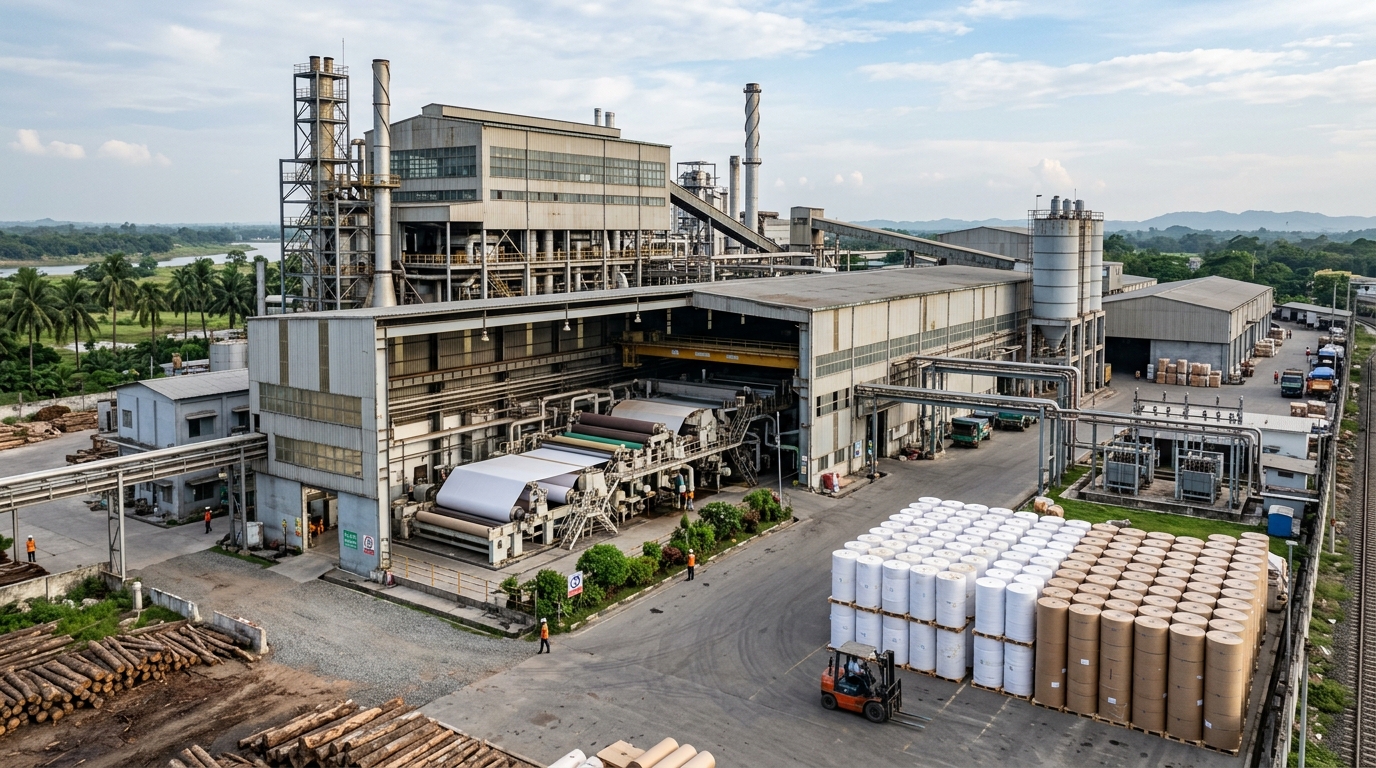
A Paper Mill in Bangladesh transforms organic ingredients into papers and boards.
The paper production consists of several parts starting from the preparation of materials to cutting or winding the finished paper as well as packaging, and ultimately distributing it.
Depending on the nature of the final product, a Paper Mill in Bangladesh can employ virgin pulp, recycled paper, imported pulp, agricultural by-products, or some combination of all of these options.
Exactly what happens in each particular case depends upon the following factors:
- The paper criterion
- The required GSM
- Finishing parameters
- Different resistances and properties of the paper
- The purpose of the paper
- The requirements for recycling
- The specific requirement of each customer
Raw Materials Used by a Paper Mill in Bangladesh
Raw materials are an essential part of the paper-making process. In Bangladesh, the paper mills can get their raw materials locally or internationally or through a combination of them.
1. Wood and Bamboo
Wood and bamboo are two types of raw materials that provide cellulose. In fact, bamboo has always been a wood species used in the paper industry in Bangladesh.
2. Recycled Paper
The paper that is obtained through recycling of wastage paper products is called recycled paper, which is used in the production of this type of paper as well as paper-based products.
3. Imported Pulp
Some manufacturers prefer using the imported pulp to get the required quality and other characteristics.
4. Agricultural Residues
Agricultural products like bagasse have been used as the source of fibers.
The North Bengal Paper Mills have recorded this trend of utilizing bagasse.
5 Additives and Chemicals
The use of chemicals and additives is based on the characteristics of a particular paper grade.
How Does a Paper Mill in Bangladesh Manufacture Paper?
Although production systems vary between mills, the basic manufacturing process follows a logical sequence.
Step 1: Raw Material Preparation
The first stage involves preparing the raw materials.
Wood, bamboo, recycled paper, or other fibres are sorted, cleaned, processed, and prepared for pulping.
For recycled paper, contaminants such as plastics, metals, adhesives, and other unwanted materials may need to be removed.
Step 2: Pulping
Pulping separates useful fibres from the raw material.
Different technologies may be used depending on the material and desired product.
The result is a fibre-rich pulp that can be processed into paper.
Step 3: Screening and Cleaning
The pulp is screened to remove unwanted particles and contaminants.
Cleaning is particularly important when recycled materials are used.
Step 4: Refining
Refining changes the physical characteristics of the fibres and helps improve the properties of the finished paper.
The process can influence fibre bonding, strength, formation, and other characteristics.
Step 5: Paper Formation
The prepared pulp is diluted and distributed across a moving forming surface.
Water is removed while fibres form a continuous web.
This is one of the most important stages in a Paper Mill in Bangladesh because the formation process directly influences the uniformity and quality of the finished sheet.
Step 6: Pressing
The newly formed sheet contains a significant amount of water.
Pressing mechanically removes additional water and increases the solids content of the paper.
Step 7: Drying
The paper passes through heated drying sections to remove remaining moisture.
Moisture control is essential because excessive or insufficient moisture can affect paper performance.
Step 8: Finishing
Depending on the required product, paper may undergo calendaring, coating, sizing, cutting, rewinding, or other finishing processes.
Step 9: Quality Inspection
The finished product is tested against relevant specifications.
Quality control may include measurements for GSM, moisture, thickness, brightness, strength, smoothness, and other properties.
Step 10: Packaging and Distribution
Finally, finished paper is packaged and transported to distributors, retailers, printing companies, manufacturers, institutions, and other customers.
Major Types of Paper Produced in Bangladesh
Different industries require different types of paper.
A Paper Mill in Bangladesh may manufacture or supply several categories depending on its machinery and production capabilities.
| Paper Type | Common Applications |
| Printing Paper | Books, documents, commercial printing |
| Writing Paper | Notebooks, stationery and office use |
| Newsprint | Newspapers and publications |
| Packaging Paper | Bags, wrapping and packaging |
| Duplex Board | Boxes and product packaging |
| Tissue Paper | Hygiene and household products |
| Industrial Paper | Manufacturing and industrial applications |
| Specialty Paper | Specific technical or commercial applications |
The specifications can vary considerably between manufacturers.
Understanding GSM in Paper Manufacturing
GSM is the most widely used standard in the paper industry. GSM means grams per square meter. GSM shows the weight of one square meter of the paper sample.
For example, this paper for writing is lighter than paperboard with a higher GSM.
The buyer should indicate the required GSM when buying from a paper mill in Bangladesh instead of just using words like “heavy paper.”
The GSM affects:
- Paper weight
- Printing capabilities
- Folding properties
- Packaging abilities
- Shipping costs
- Appearance of the product
What Quality Factors Should Buyers Check?
Only choosing paper based on the price can cause issues in the future.
A business that buys from a Paper Mill in Bangladesh should take into account some technical and commercial aspects.
GSM
Check whether the true GSM conforms to the specification.
Moisture
Moisture content may have an influence on the stability in size and printing process.
Brightness and Whiteness
These factors play a significant role for printing and publishing.
Thickness
Thickness affects packing quality and printing properties.
Strength
Packaging may require tensile strength, tear strength, burst strength, or compression strength.
Surface smoothness
A smooth type of paper contributes to good quality and looks of the printed work.
Opacity
Opacity is important when the problem of show-through occurs.
Consistency
A good manufacturer meets the level of the quality throughout the production batches.
Paper Manufacturing and Sustainability
Sustainability is highly becoming essential for the global paper industry. Recycling minimizes the demand for virgin fiber and allows the manufacturers to retrieve materials from recycled paper products.
Using recycled fiber can ensure that a paper mill in Bangladesh successfully plays its role in a circular economy provided collection, sorting and processing systems, and waste management are functioning properly.
Nevertheless, sustainability does not end with the use of recycled paper.
The key issues include:
- Sustainable sourcing of fiber
- Water efficiency
- Energy efficiency
- Waste disposal
- Responsible handling of chemicals
- Recycling production waste
Managing emissions
Paper industry players can make investments in machines, wastewater treatment technologies, recycling systems, and improved resource management to enhance the environmental performance of their operations.
The Role of Technology in Modern Paper Mills
The emergence of technology has transformed methods of paper production.
With cutting-edge technology now in use, the relevant parameters can be conveniently controlled with the help of automatic devices.
By means of automation, it is possible for producers to maintain consistency of such parameters as:
- Basis weight
- Moisture content
- Manufacturing speed
- Temperature
- Pressure
- Fibre distribution
In short, the Paper Mill of Bangladesh can make an effective use of technology to improve efficiency and productivity of its manufacturing process.

Paper Industry Statistics and Historical Context
Historical World Bank data provides useful context for understanding how Bangladesh’s pulp and paper industry developed.
One World Bank document recorded production from major mills including Karnaphuli Paper Mills, Khulna Newsprint Mills, North Bengal Paper Mills, and Sylhet Pulp & Paper Mills.
For example, the documented 1982/83 figures included approximately:
| Facility | Product | 1982/83 Production |
| Karnaphuli Paper Mills | Paper | 21,340 metric tonnes |
| Khulna Newsprint Mills | Newsprint | 26,550 metric tonnes |
| Khulna Newsprint Mills | Mechanical printing paper | 4,652 metric tonnes |
| North Bengal Paper Mills | Paper | 4,795 metric tonnes |
| Sylhet Pulp & Paper Mills | Pulp | 12,128 metric tonnes |
These figures are historical rather than current industry statistics, but they illustrate the long-standing industrial foundation of paper manufacturing in Bangladesh.
More recent government resources also maintain industrial production and establishment databases through the Bangladesh Small and Cottage Industries Corporation (BSCIC).
Where Are Paper Mills Located in Bangladesh?
Manufacturing of paper and paper products is distributed across several different industrial regions in Bangladesh. Based on historical and industry studies, locations in Bangladesh such as Chattogram, Khulna, and Narayanganj identify such areas as critical for the manufacturing process for pulp, paper, and paper products.
Aside from the issues of transportation costs, access to raw materials, manpower availability, basic utilities, and distribution networks, paper manufacturing companies also need to keep in mind the implications that the location of their Paper Mill in Bangladesh have for customers.
How to Choose a Paper Mill in Bangladesh
It is important for a business to consider more than just the pricing of a supplier. Before making a choice about choosing a Paper Mill in Bangladesh, it is important to take the following aspects into consideration:
Production Capacity
As a buyer, it is essential to find out if the mill can manufacture the right quantity of the product required.
Product Range
One must ensure that the mill manufactures the whole necessary range of the product with the needed GSM grade.
Quality Control
Inquire about any specifications or tests, and find out if the mill complies with any certifications, such as the ISO ones.
Source of Raw Materials
Knowing whether the mill works with fresh wood or recycled paper can tell you if it is the right supplier.
Delivery Time
A company that relies on timely delivery will find this aspect of great importance.
Customization
The supplier should offer customized GSM, dimensions, coating, finalization, and packaging.
Technical Support
A good supplier will help the customers choose a suitable paper type.
Why Local Paper Manufacturing Matters to Businesses
Purchase from local manufacturers can offer a number of real benefits for customers.
The supplier and product may influence how the purchasing process from a Paper Mill in Bangladesh can ease domestic logistics and decrease dependency on national distribution systems.
Moreover, local producers can also be in a position to speed the process of communication and make any arrangement of orders much simpler.
In case of customers who order large quantities of supplies, building a direct connection with a paper producer might help them put the required specifications in place.
Paper Mills vs. Paper Suppliers: What Is the Difference?
The terms “paper mill” and “paper supplier” are sometimes used interchangeably, but they can represent different businesses.
A Paper Mill in Bangladesh generally manufactures paper from pulp or recovered fibre.
A paper supplier or distributor may purchase paper from manufacturers and resell it to customers.
| Factor | Paper Mill | Paper Supplier |
| Manufactures Paper | Yes | Usually No |
| Controls Production | Directly | Indirectly |
| Product Customization | Often Higher | Depends on manufacturer |
| Inventory | Production-based | Stock-based |
| Direct Technical Support | Usually Available | Depends on supplier |
| Suitable for Large Orders | Often Yes | Yes |
Understanding this distinction helps businesses determine which type of supplier best fits their requirements.
Common Applications of Paper Products
Bangladesh has the ability to serve numerous industries with its paper products.
Publishing and Printing
Books, newspapers, periodicals, advertisements, and several other printed documents depend on paper products.
Education
Schools, colleges, coaching classes, students, and teachers are major consumers of writing and printing materials.
Packaging
The use of paper and cardboard has gained considerable importance in terms of advertising and marketing.
Retail
Retailers widely make use of paper products for out-of-the-box packaging, such as paper bags, receipts, labels, and advertisements.
Industrial applications
Manufacturing companies may choose to acquire paper and cardboard products for their work processes.
Frequently Asked Questions About Paper Mills in Bangladesh
What is a paper mill in Bangladesh?
A paper mill in Bangladesh is a plant that converts pulp, recycled fiber, or any other fibrous materials into paper or paper board products.
What fibers are used for paper making?
Fibers can vary from one mill to another mill or from one product to another product. Some examples of raw materials are recycled paper, wood fibers, imported pulp, bamboo, and agricultural waste.
What kinds of papers are manufactured in Bangladesh?
Manufacturing of papers can vary from printing and writing paper, packaging papers, tissue papers, newsprint, duplex board, cartons, and some types of Industrial papers.
Do paper mills in Bangladesh use recycled materials?
Yes, paper recycling plays an important role in the manufacturing of many recycled paper and packaging products.
Is paper manufacturing process environmentally sustainable?
It depends on the production method used and the manufacturer.
What Should Businesses Look for in a Reliable Paper Manufacturer?
A good supplier should have the ability to combine quality and consistency with production capability as well as technical knowledge and reliability regarding delivery time.
While price is still a crucial factor, selecting the cheapest paper may not always provide value due to the issues with quality that could lead to printing defects and delays or even packaging failures.
Thus, assessing a proper Paper Mill in Bangladesh should imply taking into account the overall value it provides instead of only price.
When dealing with recurrent orders, one should also think of setting up specifications and quality criteria that will govern the collaboration in question.
Base Paper: Understanding Quality-Focused Paper Manufacturing
In its work, Base Paper places an emphasis on the need for dependable paper goods and uniform criteria for such products for consumers gathering information about the paper manufacturing and sourcing process.
When assessing a paper supplier, consumers must not just look at its name, but rather such quantifiable indicators as GSM, humidity, thickness, durability, brightness, surface quality, and usage purpose.
It does not matter what kind of product you need, be it for printing, publishing, packaging or postal services: the specifications must be explicitly stated so that you would be able to use paper related to your needs.
Conclusion: Understanding the Paper Industry in Bangladesh
Bangladesh has a rich history of paper making and currently provides services to many industries like printing, education, publishing, packaging, and more.
The paper and paper product industry has been developing since the time of the large-scale paper manufacturing factories and it relies upon various raw materials, production technologies, and end-use requirements.
When searching for a Paper Mill in Bangladesh, companies should keep in mind various aspects like product quality, GSM, raw materials, production capacities, constancy, technical specifications, reliability of delivery, and the ecology of the production.
Understanding these factors allows companies to make their sourcing decisions with a greater knowledge.
As the country’s industry grows, paper production will still remain an important segment in the supply chain.
If a company is looking for a paper supplier, it needs a clear vision of the paper requirements, such as specification document, list of the producers capable of providing what is required, and information about the quality of the paper produced.